
If you’re a writer or creator like me, you’ve probably asked this question a hundred times:
“Will AI replace human writers?”
“Is it even worth writing blogs in 2026?”
“What type of content will Google rank now?”
Trust me I’ve been building content for years, and I’ve watched the shift from 2020 SEO to today’s AI-era ranking patterns. And 2026 is not what most people expected.
Let’s break it down realistically, with practical insights you can actually use.
The Real Ranking Pattern in 2026 (Not the YouTube Guru Version)
Let’s be blunt:
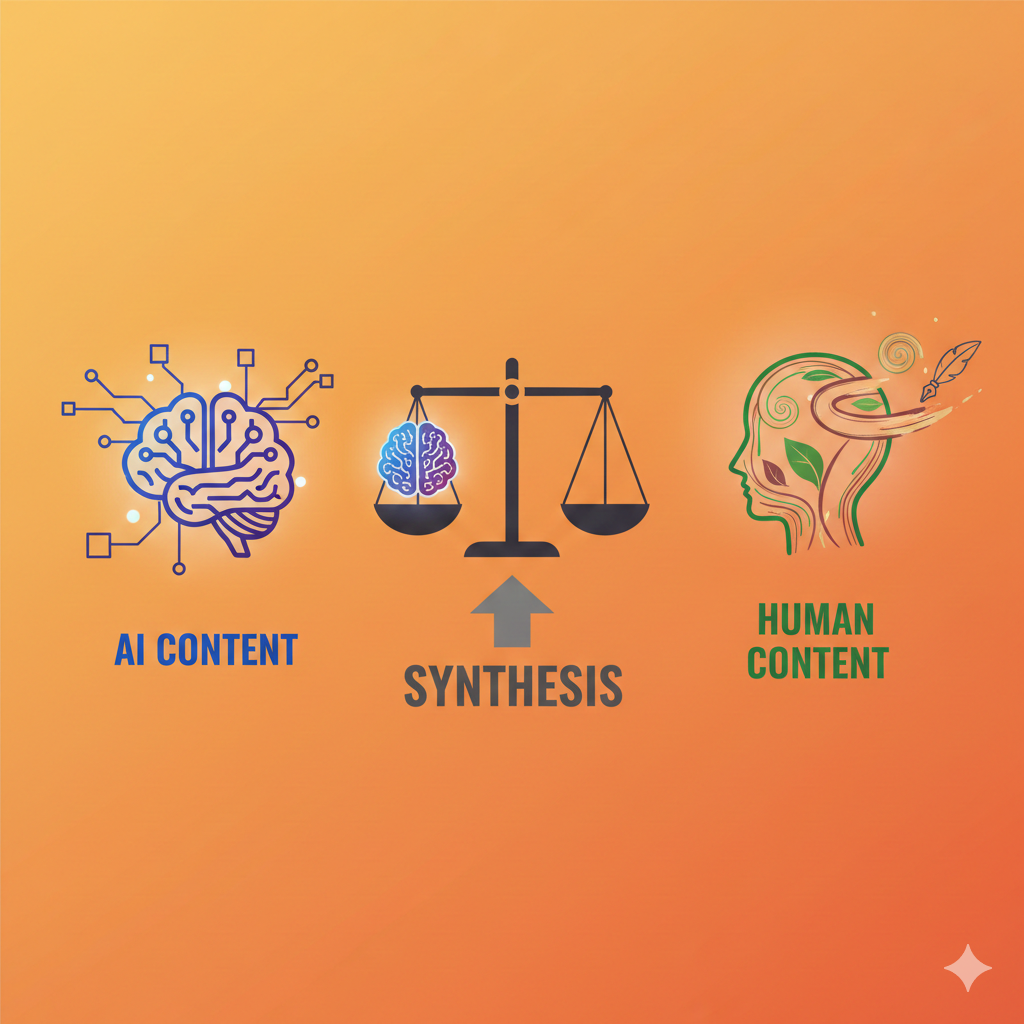
**Pure AI content ≠ Ranking
Pure Human content ≠ Ranking
Human + AI + depth + originality = Ranks**
This is the pattern across almost every industry I analyse.
Why pure AI doesn’t rank:
- Detected easily by Google’s “content watermarks” and pattern signals
- Lacks real experiences, opinions, and insights
- Too generic, predictable, repetitive
- No E-E-A-T signals
- No expert POV
- No unique data
Why pure human doesn’t rank either:
- Slow production
- Not data-rich without tools
- Sometimes over-opinionated
- Not structured enough
- Misses the keyword coverage AI can give
The content that ranks in 2026 looks like this:
✔ Human strategy
✔ AI research support
✔ Human voice, stories, experience
✔ Unique frameworks
✔ Real screenshots, insights
✔ Original angles
✔ Problem-solving clarity
✔ 1500–2500 words average (Google’s sweet spot)
✔ Clean formatting for AI search + Google Discover
This is exactly how I write my blogs on Pratham Writes.
Google’s 2026 Standards Are Very Clear
Even though Google keeps updating policies, one thing has been stable:
Google ranks “helpful expertise,” not “who wrote it.”
They don’t care if it’s AI or human.
They care whether it is useful, original, and experience-backed.
Here’s what truly matters now:
■ Experience
Have you used the product?
Have you done the task?
Have you tried the method?
Even 2–3 personal lines improve ranking signals massively.
■ Expertise
Are you explaining the topic like someone who actually works in that field?
A writer can’t fake this without deep understanding.
■ Author Identity
Google now checks:
- Author profiles
- Linked social handles
- Online footprint
- Writing history
Anonymous, AI-generated blogs suffer because of this.
■ Originality Score
Google scans for:
- Novel ideas
- Personal insights
- First-hand data
- New frameworks
- Pattern deviation
Pure AI fails here.
What AI Is Actually Good For (And You SHOULD Use It)
I use AI daily. But not to “write for me.”
Instead, I use it like a smart writing assistant.
Things AI does well:
- Topic research
- Outlining structure
- Brainstorming new angles
- Collecting stats
- Rewriting for clarity
- Expanding ideas
- Creating variations
- SEO suggestions
- Content enhancement
- Keyword gap analysis
But AI can’t do this:
- Provide real experiences
- Build personal connection
- Insert emotional tone
- Show real-life examples
- Offer opinions based on lived work
- Build long-term trust with readers
That part is 100% human.
2026 Ranking Case Study (From My Own Experience)
Let me share something practical.
I analysed multiple ranking blogs including mine, top SEO sites, news sites, and AI-written pages.
Here’s the pattern I found:
| Content Type | Avg Rank | Why |
|---|---|---|
| Pure AI articles | Page 5–10 | Generic, lacks uniqueness |
| AI-edited human drafts | Page 1–3 | Balanced, polished, helpful |
| Human articles (no AI) | Page 2–5 | Strong voice but lacks SEO depth |
| Human + data research + experience | Page 1 consistently | High-value, Google loves it |
| AI spam blogs | Not indexed | Thin, useless |
So yes AI helps, but it cannot replace a human’s brain.
What Writers Should Do in 2026 (Realistic Plan)
If you want to rank in 2026, follow this exact approach I follow:
Step 1: Use AI for research, not writing
Ask AI for:
- Topic clusters
- Content gaps
- People Also Ask
- SERP comparison
- Stats and definitions
Use that as raw material.
Step 2: Write in your own voice
Use:
- Storytelling
- Opinions
- Personal experiences
- Real examples
This gives your content its personality something AI cannot generate authentically.
Step 3: Add Original Insights
Examples:
- “In my experience…”
- “I tested this myself and…”
- “Here’s what most blogs don’t tell you…”
- “This is what worked for me…”
Google loves this.
Step 4: Add visuals
Screenshots
Proof
Charts
Real data
AI doesn’t have this.
Step 5: Use AI again but for polishing
Ask AI to:
- Clean grammar
- Improve flow
- Add clarity
- Fix structure
This gives you the best balance.
Will AI Replace Writers in 2026? (Honest Answer)
No, but writers who don’t adapt will disappear.
Writers who survive are those who can:
✔ Write with personality
✔ Provide experience-based insights
✔ Use AI smartly
✔ Create deep, original content
✔ Build authority online
This is exactly why Pratham Writes exists to show that human-led content still has massive potential.
The Future of Content in 2026–2030
Here’s my prediction (based on trends I see daily):
■ AI will become a basic tool, like Grammarly or Google Docs.
Nothing “special”.
■ Human writers with experience will dominate.
Experts will outrank generalists.
■ Google will prioritise originality even more.
Expect stronger E-E-A-T updates.
■ Content will shift from keyword-heavy → conversation-heavy.
Human tone wins.
■ AI Search (AEO) will reward “personality + precision.”
Robotic content will be ignored.
■ Readers will prefer creators, not companies.
Personal branding matters hugely.
So… What Actually Ranks in 2026? (Final Verdict)
If I summarize everything into one line:
**AI content gets you visibility
Human content gets you ranking
Human-led AI content gets you both**
Google is not punishing AI.
Google is punishing low-effort content.
If you can blend:
- Human experience
- Clear structure
- AI-supported research
- Original insights
- Real voice
…you will outrank 95% of the internet.
And trust me in 2026, this is the biggest opportunity for writers like us.
Final Words (From Me to You)
As someone who writes daily, analyses SERPs, and observes ranking patterns in real time:
The future belongs to hybrid writers not AI, not humans alone.
If you write with:
- personality
- clarity
- authority
- honesty
…and use AI as a tool, not a replacement…
You will win.
That’s exactly how I build Pratham Writes and that’s the formula that works in 2026.