
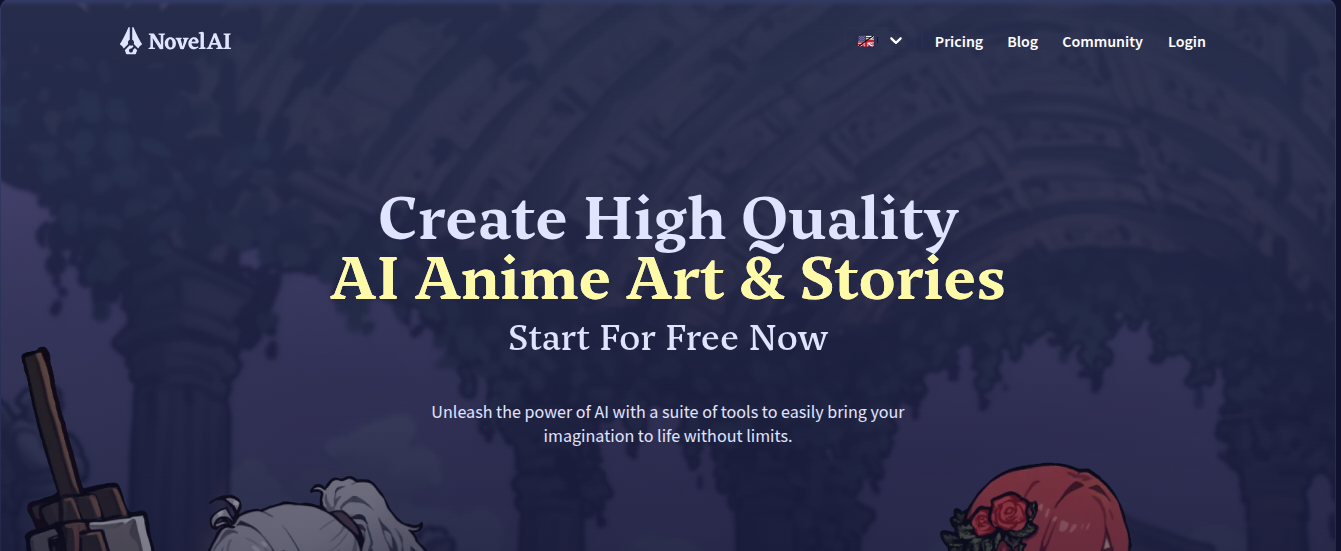
NovelAI is an AI-powered writing assistant specifically designed for creative fiction, using advanced language models to help authors continue stories, develop characters, and overcome writer’s block. Writers turn to it when they need a collaborative partner that understands narrative flow, remembers complex plot threads, and adapts to different storytelling styles. After using NovelAI for three months across multiple fiction projects from short stories to a 40,000 word novella I can offer you a genuine, unfiltered look at what this tool actually delivers versus what it promises.
What Is NovelAI?
NovelAI is a subscription-based AI writing tool built exclusively for fiction writers and storytellers. Unlike general-purpose AI assistants that handle everything from emails to code, NovelAI focuses entirely on creative narrative writing.
What sets it apart is its specialization: the AI models are trained and fine-tuned specifically for fiction, meaning they understand story structure, character development, and genre conventions in ways that general tools don’t. When you’re writing a fantasy epic or a psychological thriller, NovelAI doesn’t just predict the next word it predicts the next story beat.
The core purpose is straightforward: give fiction writers a tool that feels less like a robot and more like a creative writing partner who never gets tired, never judges your rough drafts, and always has suggestions when you’re stuck.
Who Is NovelAI Designed For?
Through my testing and conversations with other users in the NovelAI community, I’ve found it works best for:
Fiction writers who work on novels, novellas, or serialized fiction and need help maintaining momentum across thousands of words.
Novelists and short-story writers who want to experiment with different plot directions without committing to hours of writing that might get scrapped.
Role-play creators and interactive fiction writers who need dynamic, responsive narrative generation for games or collaborative storytelling.
Writers facing writer’s block who have the ideas but struggle to get words on the page, or who need a creative spark to break through stuck scenes.
However, NovelAI is explicitly not designed for SEO content, marketing copy, technical documentation, or business writing. I tested it on a blog post once out of curiosity—the results were flowery, overly descriptive, and completely wrong for that purpose. Stick to fiction, and you’ll be fine.
How NovelAI Works (Step-by-Step)
Using NovelAI feels remarkably simple once you understand the basic workflow:
1. You provide a writing prompt or starting text. This could be a single sentence (“The detective opened the door to find the room empty”) or several paragraphs of your existing story.
2. The AI generates a continuation. You can request anywhere from a few sentences to several paragraphs. The AI analyzes your writing style, story context, and any world-building details you’ve provided to create what comes next.
3. You edit, regenerate, or guide the output. Don’t like what it wrote? Regenerate for a different version. Want to steer it in a specific direction? Edit the AI’s text or add your own sentences to guide where the story goes next.
4. Control stays with you. This is crucial NovelAI doesn’t write for you; it writes with you. Every sentence it generates is a suggestion. You decide what stays, what changes, and where the story ultimately goes.
In practice, I found myself using it in short bursts: write a few paragraphs myself, generate a continuation to see where the AI takes it, cherry-pick the good parts, rewrite the weak parts, and repeat. It became less about “letting the AI write” and more about using it as a thinking partner.
Key Features of NovelAI
Story Continuation & Writing Flow
The most fundamental feature is story continuation, and it’s where NovelAI genuinely impressed me. When I fed it the opening of a mystery story I was working on, it didn’t just add random sentences it extended the scene with appropriate tension, maintained the noir tone I’d established, and even introduced a detail (a flickering streetlight) that I ended up keeping because it fit the atmosphere perfectly.
The AI understands pacing in a way I didn’t expect. Fast-paced action scenes stay tight and punchy; introspective moments slow down with appropriate detail. It’s not perfect sometimes it rushes when it should linger but the hit rate is surprisingly high.
Memory & Context Handling
This is where NovelAI separates itself from general AI tools. The platform uses what it calls “Memory” to track important story elements: character names, relationships, key plot points, and world details.
In my 40,000-word novella project, I had five main characters, two competing factions, and a complex political backdrop. I documented the essentials in Memory (character descriptions, faction motivations, world rules), and the AI consistently remembered that Marcus was the skeptical scientist, that the Syndicate controlled the eastern districts, and that magic required physical sacrifice in my world.
Why this matters: In long-form fiction, consistency is everything. Readers notice when a character’s eye color changes or when established rules suddenly don’t apply. NovelAI’s memory system isn’t flawless I caught it confusing two minor characters once but it’s far more reliable than trying to maintain context through prompts alone.
Writing Style Customization
NovelAI lets you adjust genre settings and tone parameters, and I found this more useful than I initially expected. When writing a horror short story, I set the tone to “dark” and the genre to “horror” the AI immediately started favoring ominous descriptions, building dread, and using sentence structures that created tension.
Switching to “adventure” and “lighthearted” for a different project completely changed the AI’s vocabulary and pacing. Same AI, radically different output.
The customization isn’t infinitely granular, but it gives you enough control to keep the AI aligned with your vision.
Lorebook & World-Building
The Lorebook is essentially an encyclopedia for your story world. You create entries for locations (“The Broken Crown tavern: a smuggler’s haven on the docks”), concepts (“The Fade: a mysterious illness that erases memories”), or any detail you want the AI to reference when relevant.
Here’s what I learned: The AI only pulls Lorebook entries when they’re contextually relevant. If your scene takes place in the Broken Crown tavern, the AI will reference those details. If your characters are nowhere near it, the Lorebook entry stays dormant. This prevents information overload while keeping details accessible.
I built a Lorebook with 20+ entries for my novella, and it genuinely improved consistency. When characters visited the capital city, the AI remembered it was “built on three terraced levels” and “ruled by the Council of Twelve” details I’d entered weeks earlier.
Privacy & Data Protection
NovelAI markets itself as privacy-focused, and their approach is genuinely different from major AI platforms. According to their terms, your stories aren’t used to train their models, and your content isn’t reviewed by human moderators unless you report a technical issue and explicitly share your data.
For fiction writers, this matters tremendously. Your unpublished novel, your original characters, your creative ideas these stay private. I never felt uncomfortable writing sensitive plot points or experimenting with controversial themes, which I absolutely would have felt using a platform that openly uses user data for training.
My Personal Experience Using NovelAI
I approached NovelAI with skepticism. I’d tried AI writing tools before, and they all felt like typing with a parrot technically impressive, but creatively hollow.
I started with a simple test: a fantasy short story I’d abandoned months earlier because I couldn’t figure out how the protagonist would escape a trap I’d written them into. I fed NovelAI the 3,000 words I had, explained the problem in the Memory section, and generated continuations.
The first three attempts were mediocre generic solutions I’d already considered. But the fourth attempt introduced an idea I hadn’t thought of: the protagonist using the trap’s own mechanism against the antagonist. It wasn’t perfect as written, but it sparked the solution I needed. I rewrote the escape scene entirely in my own words, keeping only the core concept the AI suggested.
That experience changed how I used the tool. I stopped expecting it to write polished prose and started treating it as a brainstorming partner. When I got stuck, I’d generate five different continuations just to see different possibilities. Sometimes I used nothing; sometimes a single sentence would unlock hours of productive writing.
Over three months, I completed two short stories and drafted 40,000 words of a novella more fiction than I’d written in the previous year. NovelAI didn’t write these stories; I did. But it removed the friction that usually stops me: the fear of the blank page, the uncertainty about what happens next, the exhaustion of solving every narrative problem alone.
What I Liked About NovelAI
The writing feels genuinely natural. This was my biggest surprise. NovelAI’s prose doesn’t sound robotic or obviously AI-generated. It makes grammar mistakes occasionally and sometimes chooses awkward phrasings, but so do human writers in first drafts. The narrative voice it generates feels organic, which makes editing it feel like editing a human collaborator’s work, not debugging code.
It assists without replacing. I never felt like NovelAI was writing my story for me. Every generation felt like a suggestion, not a mandate. This kept me engaged in the creative process instead of passive.
Idea generation is where it shines. When I hit the wall when I knew something had to happen but couldn’t figure out what NovelAI excelled at throwing out possibilities. Most weren’t perfect, but they got my brain unstuck.
Long-form consistency is impressive. For a 40,000 word project, the AI remembered character details, plot threads, and world rules remarkably well. I still had to check for errors, but far fewer than I expected.
Where NovelAI Falls Short
It’s not a magic solution. If you can’t write, NovelAI won’t write for you. It enhances your process; it doesn’t replace your skill. I’ve seen beginners get frustrated because they expected the AI to produce publish-ready prose from minimal input. That’s not how it works.
Action scenes and dialogue need heavy editing. NovelAI handles description and narrative beautifully, but fast-paced action often becomes muddled, and dialogue can sound stiff or on-the-nose. I found myself rewriting most dialogue the AI generated.
It sometimes ignores your direction. You can explicitly tell the AI “the character should feel conflicted,” and it might generate a scene where they’re perfectly confident. This happened often enough to be annoying.
The learning curve exists. Understanding how to use Memory effectively, how to structure Lorebook entries, and how to prompt for better results these all take time. My first week was frustrating; my second month was productive.
Genre limitations. While NovelAI handles fantasy, sci-fi, mystery, and romance well, I found it weaker with literary fiction and experimental styles. If your writing is highly stylized or unconventional, you’ll spend more time fighting the AI’s defaults.
NovelAI Pricing Overview
NovelAI operates on a subscription model with three tiers: Tablet ($10/month), Scroll ($15/month), and Opus ($25/month). The tiers differ primarily in how many AI generations you can request and which AI models you can access.
I subscribed to Scroll ($15/month), which gave me access to their stronger AI models and enough generation quota that I never hit limits, even during heavy writing sessions.
Here’s my honest take on value: If you’re a hobbyist who writes occasionally, $15/month might feel steep. If you’re a serious fiction writer working on a novel or regular short stories, it’s comparable to a couple of coffee-shop writing sessions per month and it genuinely helps you produce more finished work.
The people who find it worth the cost are active fiction writers who value momentum and creative partnership. If you write once a month or only work on non-fiction, save your money.
NovelAI vs Other AI Writing Tools
I’ve used ChatGPT, Claude, and several other AI writing assistants. Here’s what actually differentiates NovelAI:
ChatGPT and Claude are generalists. They’re brilliant for many tasks, but they’re not optimized for long-form fiction. They’ll lose track of plot threads, forget character details, and their writing style feels more “essay-like” than narrative.
NovelAI stays niche-focused. It does one thing fiction and does it well. The AI models understand story structure and genre conventions because they’re specifically trained for this purpose.
When to choose NovelAI: You’re writing a novel, you need consistent characterization across tens of thousands of words, and you want a tool that feels like a creative partner, not a generic assistant.
When to choose general AI tools: You need versatility, you’re working on non-fiction, or you only need occasional creative help and don’t want another subscription.
Is NovelAI Beginner-Friendly?
Yes and no.
The interface is straightforward you type, you generate, you edit. A beginner can start writing immediately without technical knowledge.
But here’s the reality: Beginners who expect the AI to do the heavy lifting get disappointed quickly. The tool rewards writers who already understand story structure, character development, and narrative pacing. It enhances existing skills; it doesn’t teach them.
I watched a friend who’s never written fiction try NovelAI. She got frustrated because the AI kept generating scenes that didn’t “make sense” together. The issue wasn’t the AI it was that she didn’t yet understand how scenes connect narratively. The AI generated perfectly reasonable continuations, but she didn’t have the framework to evaluate or guide them.
Experienced writers adapt quickly because they already know what they want; they just need help executing it. Complete beginners will have a steeper learning curve.
Pros and Cons Summary
Pros
- Natural, fiction-appropriate writing style that feels organic rather than robotic
- Excellent memory and context handling for long-form stories
- Privacy-focused platform that doesn’t use your content for training
- Effective idea generation and writer’s block assistance
- Genre and tone customization that genuinely affects output quality
- Lorebook system enables complex world-building consistency
Cons
- Subscription cost may be prohibitive for hobbyist writers
- Requires existing writing skills to use effectively
- Dialogue and action scenes often need substantial editing
- AI occasionally ignores explicit direction or forgets details
- Learning curve for Memory and Lorebook optimization
- Not suitable for non-fiction, marketing, or technical writing
- Weaker performance with literary or experimental fiction styles
Should You Use NovelAI?
Subscribe if: You’re an active fiction writer working on novels or regular short stories, you struggle with writer’s block or maintaining momentum, and you’re looking for a creative partner that helps you write more consistently. If you’re already spending money on writing tools or courses, redirecting $15/month to NovelAI will likely give you better results.
Avoid it if: You only write occasionally, you’re focused on non-fiction or commercial content, or you’re expecting the AI to write publication-ready prose without your involvement. Also skip it if you’re on a tight budget and not writing seriously enough to justify the monthly cost.
My honest recommendation: NovelAI is the best AI tool I’ve found specifically for fiction writing, but it’s a tool, not a miracle worker. If you’re committed to writing fiction and willing to learn how to collaborate with AI effectively, it will accelerate your productivity and help you finish projects. If you’re just curious or hoping it’ll write your novel for you, you’ll be disappointed.
I’m keeping my subscription because it’s helped me write more fiction in three months than I had in the previous year. That return on investment is clear enough for me.
FAQs About NovelAI
NovelAI is accessible for beginners, but it works best for writers who already have basic storytelling skills. If you understand character development, plot structure, and narrative pacing, you’ll adapt quickly. Complete beginners might find the learning curve steeper because the AI enhances your decisions rather than making them for you. I’d recommend taking a creative writing course or reading craft books alongside using NovelAI if you’re just starting out.
Technically, yes—the AI can generate hundreds of thousands of words. Practically, no—it can’t write a coherent, publish-ready novel without extensive human guidance and editing. What it can do is help you write a full novel by assisting with difficult scenes, generating ideas when you’re stuck, and maintaining consistency across long manuscripts. In my experience, the AI contributed maybe 20-30% of raw text to my novella draft, with the rest being my original writing or heavy revisions of AI suggestions.
Based on their published privacy policy and terms of service, yes. NovelAI states they don’t use your content to train AI models and don’t share your stories with third parties. Your writing is encrypted, and human review only happens if you explicitly share content when reporting technical issues. For fiction writers concerned about idea theft or premature exposure of unpublished work, NovelAI’s privacy approach is significantly stronger than platforms that openly use user data for training.
For long-form fiction specifically, yes—NovelAI outperforms ChatGPT in my testing. ChatGPT is more versatile overall, but NovelAI’s specialized training means it handles narrative consistency, genre conventions, and storytelling structure better over thousands of words. ChatGPT tends to lose track of plot threads and character details more quickly, and its writing style feels more like “explaining a story” than “telling a story.” That said, ChatGPT is free and excellent for brainstorming or one-off creative exercises. For serious novel writing, NovelAI justifies its subscription cost.
Conclusion
After three months of real-world use across multiple fiction projects, NovelAI has proven itself as a legitimate creative partner for fiction writers not a replacement for skill, but a genuinely useful tool for enhancing productivity and overcoming the blank page.
It won’t write your novel for you, but it will help you write your novel yourself, which is exactly what a good tool should do. The privacy protections give me confidence to work on unpublished projects, the memory system keeps long stories consistent, and the specialized fiction training means I spend less time fighting the AI and more time actually writing.
Is it perfect? No. Does it justify the subscription cost for serious fiction writers? In my experience, absolutely.
If you’re on the fence, I’d suggest trying it for one month with a specific project in mind not to test if the AI can write for you, but to test if it helps you write better yourself. That’s where NovelAI’s real value lives, and that’s where you’ll find out if it’s the right tool for your creative process.