
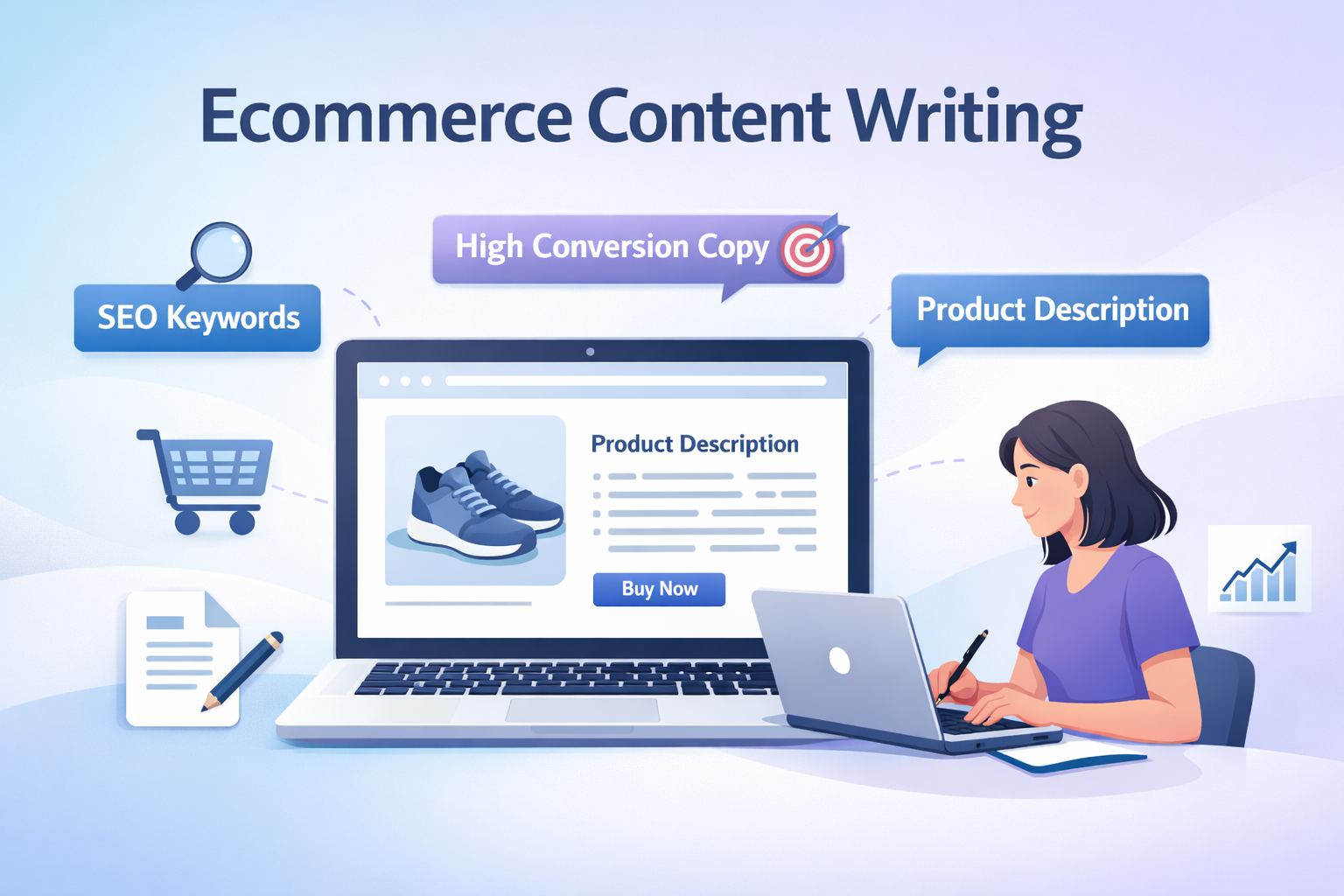
Ecommerce content writing is the process of creating product descriptions, category pages, blogs, and marketing copy that attract, inform, and convert online shoppers. The goal is not just traffic but sales.
Most ecommerce stores invest in ads, inventory, and design. But they skip the one thing that actually closes the sale: the words on the page.
This guide breaks down everything you need to know about ecommerce content writing, from product pages to SEO strategy to real before-and-after examples.
What Is Ecommerce Content Writing?
Ecommerce content writing is writing created specifically to sell products online.
It covers product descriptions, category pages, blog posts, landing pages, and email copy. Every piece serves one goal: move the shopper closer to a purchase.
How it differs from regular content writing:
Regular content writing informs. Ecommerce content writing converts.
A travel blog post tells you about a destination. An ecommerce product page has to make you buy the backpack you’ll need for the trip. That shift changes everything about how you write.
Three core focuses set ecommerce writing apart:
Conversion comes first. Every word should push the reader toward action. Clarity is non-negotiable. Confused shoppers do not buy. Trust matters more than creativity. Shoppers need to feel confident before they spend money.
Why Ecommerce Content Writing Matters
Most ecommerce stores that fail do not fail because of bad products. They fail because of bad content.
Here is what poor content actually costs you:
SEO rankings drop. Google ranks pages with clear, relevant, well-structured content. Thin or duplicate content gets buried. Buried pages get no traffic. No traffic means no sales.
Conversion rates stay low. The average ecommerce conversion rate is around 2-3%. Stores with strong, benefit-focused content consistently outperform that. Stores with weak copy stay stuck at the bottom.
Customer trust disappears. Shoppers cannot touch or try your product. Your words have to do that job. Generic, vague descriptions feel untrustworthy. Specific, clear copy builds confidence.
A simple proof of concept:
Two stores sell the same wireless earbuds. Store A uses the manufacturer copy: “Bluetooth 5.0 earbuds with 8-hour battery.” Store B rewrites it: “Stay connected all day without ever hitting pause to recharge. These earbuds last 8 hours on a single charge, with a compact case that adds 24 more hours in your pocket.” Store B wins the sale almost every time.
Same product. Better content. More conversions.
Types of Ecommerce Content
Ecommerce content is not one-size-fits-all. Each content type serves a different role in the buyer journey.
Product Descriptions
This is the highest-stakes ecommerce content you will write. When a shopper lands on a product page, they are already interested. Your description either closes the deal or loses it.
Short descriptions (2-4 lines) appear near the price and product title. They need to deliver the core benefit immediately.
Long descriptions appear further down the page. They go deeper into features, use cases, and objections. They also give you room to work in keywords naturally.
The biggest mistake most stores make: writing features, not benefits. Shoppers do not care about specs in isolation. They care what those specs do for their life.
Category Pages
Category pages are one of the most overlooked opportunities in ecommerce SEO.
These pages rank for broad, high-volume keywords. A “Men’s Running Shoes” category page can pull in thousands of monthly visitors if it is optimized correctly. Most stores leave these pages blank or write two generic sentences.
A strong category page includes a short intro paragraph with target keywords, a brief explanation of what the category covers, and maybe a buying guide section to help shoppers decide.
Blog Content
Blog posts do not sell directly. They attract shoppers who are still deciding.
A shopper searching “best protein powder for beginners” is not ready to buy yet. But if your blog post answers their question, they land on your site. You earn their trust. They discover your products. That is how blog content turns into revenue.
Blog posts also build topical authority, which improves your rankings across your entire site.
Landing Pages
Landing pages are built for campaigns. You run a paid ad, and the ad sends traffic to a focused page with one goal: get the conversion.
Unlike product pages, landing pages strip away distractions. No navigation menus pulling attention away. No related products. Just a headline, the offer, the benefits, social proof, and a call to action.
Email Content
Email is where you retain customers and drive repeat sales.
Welcome sequences onboard new buyers. Abandoned cart emails recover lost sales. Post-purchase flows build loyalty. Promotional emails move inventory.
Email content is written differently from web content. It is more personal, more conversational, and far shorter. But it is still ecommerce content, and it still needs to be optimized for conversion.
Ecommerce Content Writing Framework
This is the repeatable process that works across product types and industries.
Understand Your Customer First
Before you write a single word, you need to know who you are writing for.
Ask these questions: What problem is this product solving? What does the shopper already know about this product category? What objections might hold them back from buying? What outcome are they hoping for?
Buyer personas help here, but even basic research goes a long way. Read reviews on your competitors’ products. See exactly how customers describe what they want and what they hate. Use that language in your copy.
Do Keyword Research Before You Write
Every piece of ecommerce content should be built around search intent.
Buyer intent keywords are what you target on product and category pages. These are searches like “buy noise-canceling headphones” or “best yoga mat for beginners.” People using these terms are close to purchasing.
Informational keywords are what you target in blog content. These are searches like “how to choose a yoga mat” or “what to look for in headphones.” People using these terms are researching, not buying yet.
Use tools like Ahrefs, SEMrush, or Google’s free Keyword Planner to find keywords with real search volume and manageable competition.
Lead With Benefits, Not Features
This is the rule that separates strong ecommerce copy from weak ecommerce copy.
Features describe the product. Benefits describe what the product does for the buyer.
Feature: “5000mAh battery.” Benefit: “Lasts all day without charging, even with heavy use.”
Feature: “Made from 100% merino wool.” Benefit: “Naturally temperature-regulating so you stay comfortable in heat or cold.”
Features belong in your copy. But they should always be paired with or preceded by the benefit they deliver.
Write for Scanners
Online shoppers do not read. They scan.
They look at headlines, bullet points, bold text, and product images. If they cannot find what they need in a quick scan, they leave.
Structure your product pages and blog posts accordingly. Use short paragraphs of two to three sentences maximum. Use bullet points for feature lists. Use subheadings to break up long sections. Bold key phrases that shoppers are likely to be searching for.
Dense walls of text kill conversion rates.
Add Trust Signals Throughout
Shoppers need reassurance before they spend money online.
The most powerful trust signals in ecommerce content include customer reviews and ratings (quoted directly on the page), satisfaction guarantees and return policies stated clearly near the buy button, social proof like “Over 10,000 customers” or “As seen in Forbes,” and specific, verifiable claims instead of vague superlatives like “the best.”
Trust signals reduce purchase anxiety. Less anxiety means more conversions.
How to Write High-Converting Product Descriptions
Product descriptions are where most ecommerce content fails. Here is a method that works.
The first two lines are everything. Shoppers decide in seconds whether to keep reading. Your opening line needs to hook them immediately. Lead with the most compelling benefit or the problem this product solves.
Use the Problem-Solution-Benefit structure:
State the problem the buyer faces. Present the product as the solution. Show the benefit they get as a result.
“Tired of earbuds that fall out mid-run? [Product Name] locks in place through your toughest workouts and stays put for up to 8 hours. Train harder without stopping to adjust your gear.”
Use plain language. Avoid industry jargon unless your audience specifically uses it. Write like you are explaining the product to a friend.
Add emotional triggers where appropriate. Confidence, comfort, convenience, status, and security are the big ones in ecommerce. Not every product needs emotional language, but most benefit from it.
Include a mini FAQ section. Answer the top two or three questions shoppers always ask about this product type. This reduces hesitation and handles objections before they become reasons to leave.
A template you can use immediately:
Headline: Lead with the core benefit. Quick benefit statement: One to two sentences on what the shopper gets. Key features with benefits paired: Three to five bullet points. Use case: One sentence on who this is for or when to use it. Call to action: Clear and specific.
Ecommerce SEO Content Strategy
Good content that no one finds is wasted content. SEO makes sure your writing actually gets seen.
Target Long-Tail Keywords
Long-tail keywords are more specific search phrases with lower competition and higher purchase intent.
“Shoes” is impossible to rank for. “Waterproof trail running shoes for wide feet” is achievable and converts better because the searcher knows exactly what they want.
Build your product and category page content around these specific phrases.
Match Content to Search Intent
Every keyword has an intent behind it. Write content that matches that intent exactly.
Informational intent: Blog posts, buying guides, comparison articles. Navigational intent: Brand and product-specific pages. Transactional intent: Product pages, category pages, landing pages.
If a shopper searches “how to clean leather boots,” they want a guide, not a product page. If they search “buy leather boot cleaner,” they want a product page, not a guide.
Mismatched content fails in both SEO and conversion.
Build Internal Links Strategically
Every blog post you write is an opportunity to link to a relevant product or category page.
A post on “how to choose a running shoe” should link to your running shoe category page. A post on “best protein powder for weight loss” should link to relevant product pages.
Internal links pass authority from high-ranking content pages to your product pages. They also guide shoppers naturally through the buying journey.
Optimize Page Titles and Meta Descriptions
Your title tag and meta description are your ad in the search results. Write them like copy, not just labels.
Title: Include your primary keyword near the front. Keep it under 60 characters. Make it specific and compelling. Meta description: Include a secondary keyword. State the benefit of clicking. Keep it under 155 characters.
Common Ecommerce Content Mistakes to Avoid
These mistakes are everywhere. They are also fixable.
Using manufacturer or supplier descriptions. These are the same descriptions on every other store selling that product. Google penalizes duplicate content. Shoppers have already seen it. Write originals every time.
Writing only about features. Features without benefits leave shoppers doing the translation work themselves. Many will not bother.
Ignoring SEO on product pages. Product pages are not just about conversion. They also need to rank. Include keywords naturally in titles, descriptions, and image alt text.
Skipping emotional connection. Not all copy needs to be emotional. But most product categories have at least one emotional angle worth using. Ignoring it leaves persuasion power on the table.
Using weak or vague calls to action. “Click here” and “Buy now” are not calls to action. “Get same-day delivery” or “Add to cart and save 20% today” tell the shopper exactly what they get by clicking.
Writing long, unbroken paragraphs. Shoppers scan. If your description is a wall of text, they bounce.
Tools for Ecommerce Content Writing
These are the tools worth actually using.
For keyword research: Ahrefs and SEMrush are the gold standard. Both show search volume, keyword difficulty, and competitor rankings. Google Keyword Planner is free and useful for early-stage research.
For AI assistance: AI tools work well for generating first drafts, headline variations, and feature-to-benefit rewrites. They are not a replacement for a human writer who understands the product and the customer. Use AI to speed up the process, then edit for accuracy and voice.
For grammar and clarity: Grammarly catches errors and flags overly complex sentences. Hemingway Editor helps you write for readability. Both are worth using before publishing.
For readability scoring: The Flesch-Kincaid readability score built into Hemingway Editor gives you a quick read on whether your copy is accessible. Aim for a Grade 6 to Grade 8 reading level for most ecommerce audiences.
Real Examples: Before and After
Nothing teaches ecommerce content writing faster than seeing the difference side by side.
Bad product description:
“Stainless steel water bottle. 32oz capacity. BPA free. Keeps drinks cold for 24 hours. Available in multiple colors.”
This is a spec sheet, not a description. It lists facts with no benefit framing, no emotional angle, and no reason to choose this bottle over the hundred other options.
Improved version:
“Keep your water ice-cold from morning meeting to evening gym session. This 32oz stainless steel bottle holds cold drinks for up to 24 hours, fits most car cup holders, and is completely free of BPA and toxins. One fill lasts all day. Toss it in your bag, your car, or your gym locker — it handles everything.”
Why the second version works:
It opens with a benefit the shopper immediately relates to. It keeps the specs but frames them around real-life use. It answers the question “will this fit in my car cup holder?” before the shopper has to ask. It ends with a use-case that makes the product feel practical and reliable.
The product is identical. The copy is not. That gap is where sales happen.
Ecommerce Content Strategy for Long-Term Growth
Single pieces of content are useful. A connected content system is how you scale.
Combine SEO with CRO (conversion rate optimization). SEO brings in traffic. CRO turns that traffic into sales. You need both. Ranking a product page that converts at 0.5% is less valuable than ranking one that converts at 3%.
Build a content funnel:
Blog content at the top attracts organic traffic from informational searches. That traffic discovers your products and moves to product and category pages. Email captures subscribers and moves them toward repeat purchases. Retargeting ads bring back shoppers who browsed but did not buy.
Each content type feeds the next. Blog posts are not just for traffic. They are the entry point into your sales system.
Prioritize your highest-revenue pages first. You cannot rewrite everything overnight. Start with the product pages that drive the most revenue. Get those right. Then work outward.
Update content regularly. Product descriptions go stale. Blog posts fall in rankings when competitors publish better versions. Build a quarterly content review into your process.
Conclusion
Good ecommerce content does not just describe products. It sells them.
Every word on your product page either builds trust or breaks it. Every sentence on your category page either ranks or disappears. Every blog post either attracts a future buyer or misses the opportunity entirely.
The gap between a store that struggles and a store that scales is often not the product. It is the content.
Start today with one product page. Pick your best-selling item. Rewrite the description using the Problem-Solution-Benefit structure. Add three to five benefit-focused bullet points. Include a clear call to action.
That one page rewrite will show you exactly what better ecommerce content writing can do for your sales.
FAQs
Ecommerce content writing is the creation of product descriptions, category pages, blog posts, landing pages, and email copy designed to attract shoppers and convert them into buyers.
Lead with the core benefit, not the feature. Use short paragraphs and bullet points. Address buyer objections directly. End with a clear call to action.
Yes. SEO determines whether your content gets found. Without it, even the best product descriptions sit on pages that no one visits.
It depends on the product. Simple, familiar products can convert with 50-100 words. Complex or high-ticket products often need 300-500 words or more to address buyer questions and build confidence.
AI can generate useful drafts and speed up the writing process. But AI-generated content needs human editing to ensure accuracy, brand voice, and genuine benefit framing. Use AI as a starting point, not a final product.